
Natural, recycled or everyday: which insulation suits your loft?
All of these keep heat in. Here’s how they differ, from sheep’s wool to mineral wool, and where each one makes sense.
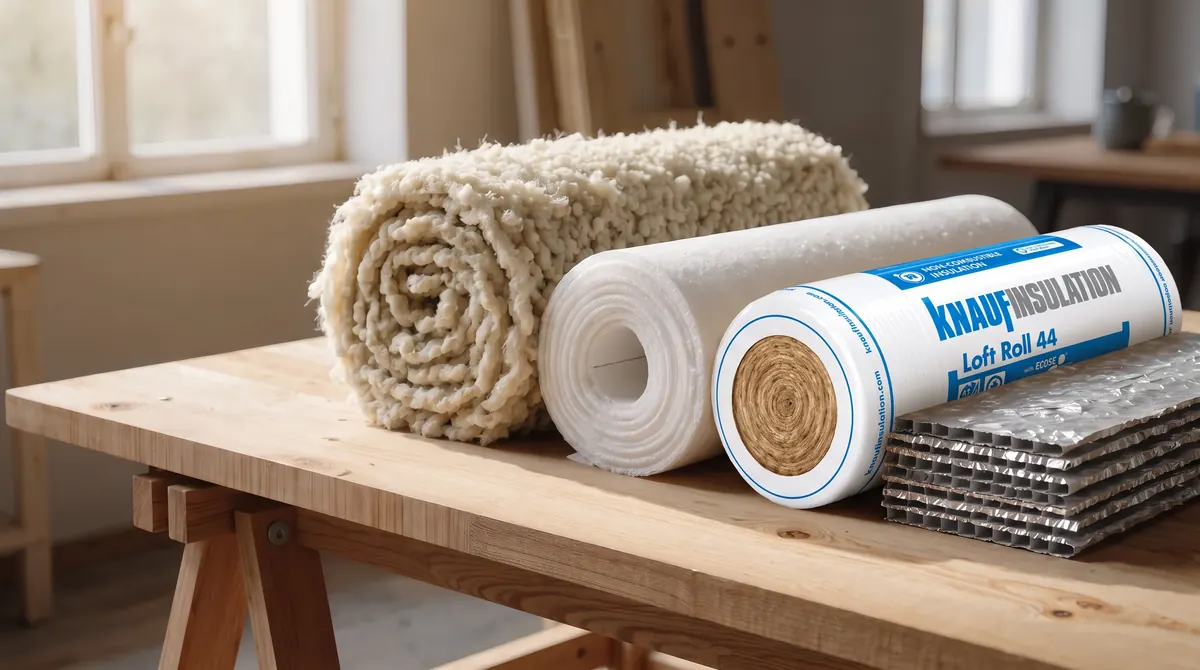
Illustration: loft insulation materials side by side
| Material | Typical lambda (W/mK) | Best for |
|---|---|---|
| Sheep’s wool | Depends on how it is fitted | |
| Recycled plastic (polyester) | Depends on how it is fitted | |
| Mineral wool | Depends on how it is fitted | |
| Blown (loose-fill) | Depends on how it is fitted | |
| Multifoil | Depends on how it is fitted | |
| Rigid board (PIR) | Depends on how it is fitted |
Lower lambda means less thickness is needed for the same effect. Ranges are typical; each product’s declaration of performance gives its exact figure. We recommend a material for your loft in our quotation.
- Sheep’s wool loft insulation
- Sheep’s wool loft insulation: how well it works, why it suits older homes, what it costs compared with mineral wool, and how it’s fitted.
- Recycled plastic (polyester) loft insulation
- Recycled polyester loft insulation explained: what it’s made from, how it feels to handle and how it compares with wool and mineral wool.
- Mineral wool loft insulation
- Mineral wool loft insulation explained plainly: what it’s made of, how it’s laid and how it compares with sheep’s wool and recycled options.
- Blown (loose-fill) loft insulation
- Blown (loose-fill) loft insulation: when it’s the right choice, how it’s installed through the hatch and how deep it goes.
- Multifoil loft insulation
- Multifoil (superfoil) insulation explained: thin, quilted foil fixed under the roof where there’s no room for deep wool.
- Rigid board (PIR) loft insulation
- When rigid PIR boards make sense in a loft: cut between the floor joists where depth is limited, usually under a boarded floor.
Find out what your loft needs, in plain words
Tell us about your home. We’ll explain the options and send a written quote. No obligation.