
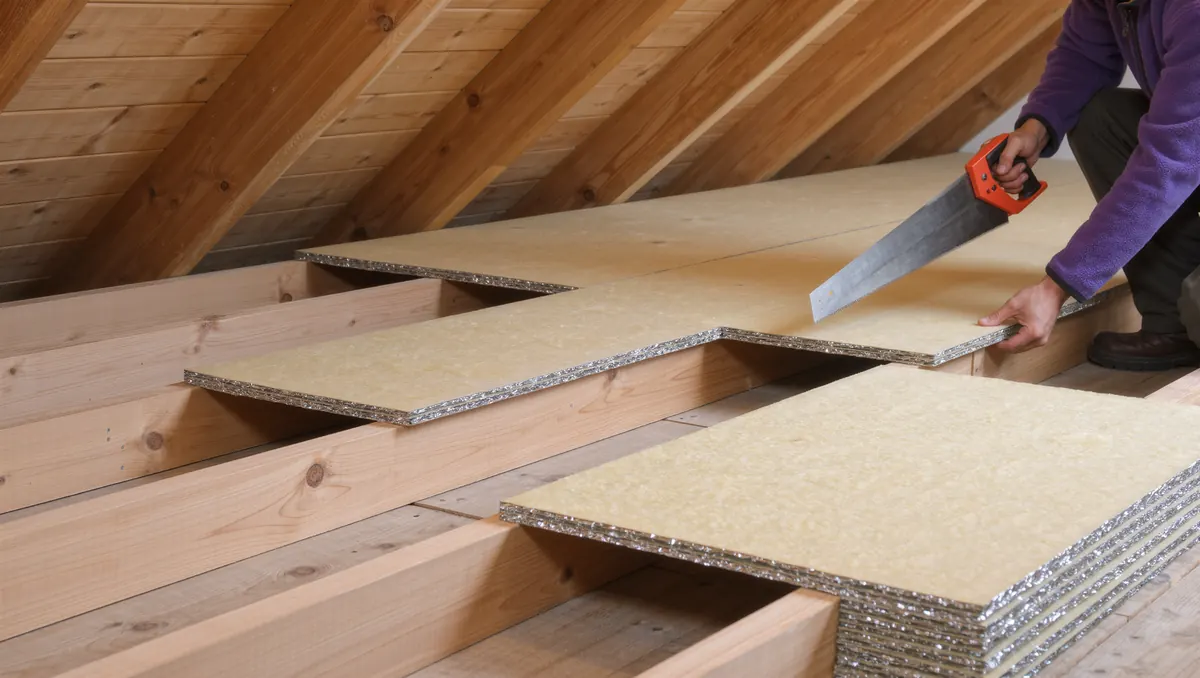
Rigid insulation boards: slim insulation under a loft floor
Foil-faced foam boards insulate well for their thickness. In a loft we use them on the floor, cut between the joists, where there isn’t room for deep wool.
Illustration: rigid boards fitted between the joists
| What it is | Rigid foam (PIR) with foil on both faces |
|---|---|
| Comes as | Boards, cut to fit |
| Where it goes | Between the floor joists, often under boarding |
| Good for | Where floor depth is limited |
| Worth knowing | Not a natural material; more costly than wool for most lofts |
When boards make sense
Most lofts are best insulated with wool, which is cheaper and fills every gap. Boards come into their own where depth is limited, for example under an existing floor you want to keep at the same height.
How we fit them
Boards are cut to fit tightly between the floor joists, with the joints taped, and a floor can be laid over them. We don’t fix boards to the rafters.
If you prefer natural materials
Boards are made from foam, not natural fibres. If that matters to you, there’s usually a way to do the job with wool instead; we’ll explain the trade-off.
Common questions
Are boards better than wool?
Do you put boards on the rafters?
Can you board over them?
Find out what your loft needs, in plain words
Tell us about your home. We’ll explain the options and send a written quote. No obligation.