
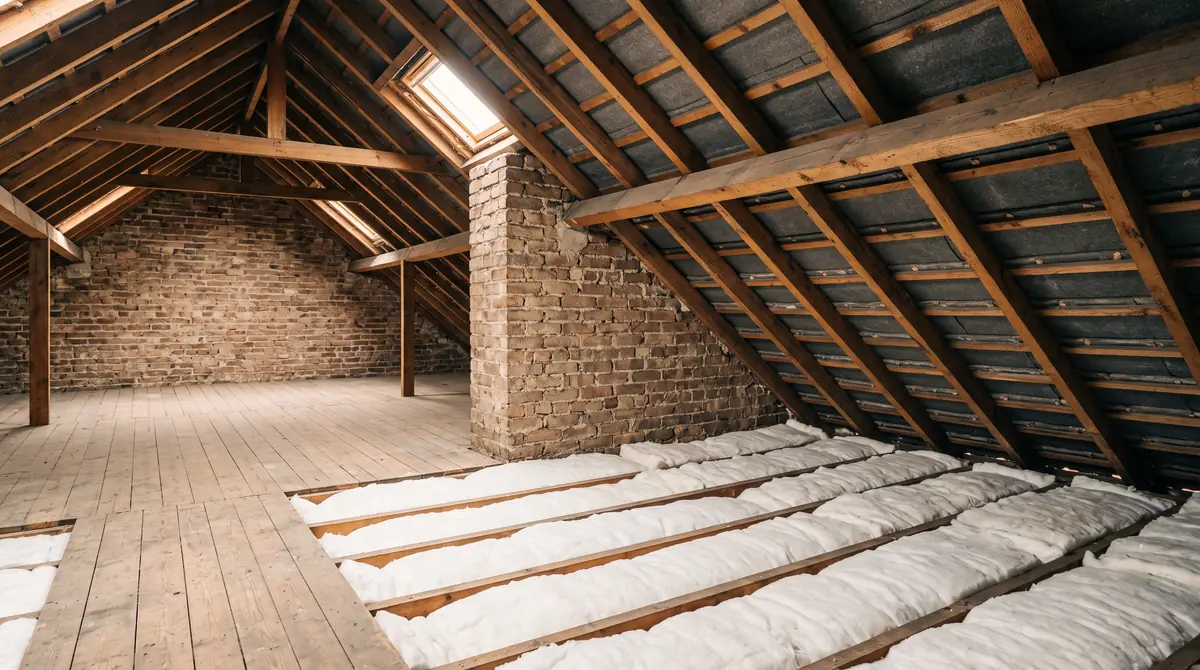
Post-war houses: simple lofts, quick to get right
Houses built after the war usually have plain, practical lofts. Most need a top-up or a fresh layer, and the job is often quick.
Illustration: a post-war loft
| Typical loft | Simple pitched roof, sawn timbers, concrete tiles |
|---|---|
| What suits it | Any wool laid on the floor, between and over the joists |
| Watch for | Thin old insulation, cold-water tanks |
| Airflow | Check the eaves are clear |
Straightforward roofs
Post-war homes were built quickly and practically. The lofts tend to be uncomplicated: a simple pitched roof, sawn timbers and a plain gable wall. That makes them easy to insulate properly.
The usual job
Often a thin layer is already there. If it’s dry and sound, we top it up with a layer across the joists. If it’s been disturbed or spoiled, we start again.
Choosing a material
All the wools work here. Recycled polyester is a nice option if you visit the loft often and want something clean to handle.
Common questions
How long does it take?
Most post-war lofts are done within a day.
Will you keep my old insulation?
If it’s dry and sound, yes, and we top it up.
Do I need extra vents?
Sometimes. We check the eaves and tell you in the quote.
Find out what your loft needs, in plain words
Tell us about your home. We’ll explain the options and send a written quote. No obligation.